domingo, 10 de mayo de 2020

1º ESO 11th to 15 MAY HOMEWORK

Bitmoji Image


TASK 1. WATCH THE VIDEO AND ANSWER THESE QUESTIONS (ESTÁNDAR 1.1.1)


1. Why is it Camden Town famous for? 
2. Why do people go to Camden Market?
3. Apart from clothes, what else can you find in this market?
4.What is Kate wearing?
5. What is Elizabeth wearing?
6. Would you like to go to this market? what would you buy?


Clientmoji
5 years ago I moved to London and I lived near Camden Town. I used to spend the whole day in this market, I loved it!! 


TASK 2. COPIA ESTOS ESQUEMAS EN TU LIBRETA Y HAZ LOS EJERCICIOS. (ESTÁNDAR 4.1.4)


Pasado Simple – (Simple Past Tense) | Aprender Inglés Fácil


Form (Forma)

Para formar el pasado simple con verbos regulares, usamos el infinitivo y añadimos la terminación “-ed”. La forma es la misma para todas las personas (I, you, he, she, it, we, they).
Ejemplos:
want →   wanted
learn →   learned
stay →   stayed
walk →   walked
show →   showed
Excepciones:
1. Para verbos que terminan en una “e”, sólo añadimos “-d”.
Ejemplos:
change →   changed
believe →   believed
2. Si el verbo termina en una vocal corta y una consonante (excepto “y” o “w”), doblamos la consonante final.
Ejemplos:
stop →   stopped
commit →   committed
3. Con verbos que terminan en una consonante y una “y”, se cambia la “y” por una “i”.
Ejemplos:
study →   studied
try →   tried

SI EL VERBO ES IRREGULAR, USAREMOS LA 2ª COLUMNA. TENÉIS UNA LISTA DE VERBOS IRREGULARES EN VUESTRO CUADERNILLO

 USO: El pasado simple se utiliza para hablar de una acción concreta que comenzó y acabó en el pasado. En este caso equivale al pretérito indefinido español. Generalmente, lo usamos con adverbios de tiempo como “last year”“yesterday”“last night”
Ejemplos:
Tom stayed at home last night.(Tom se quedó en casa anoche.)
Kate worked last Saturday.(Kate trabajó el sábado pasado.)
didn’t go to the party yesterday.(No fui a la fiesta ayer.)
Did they walk to school this morning?(¿Han andado a la escuela esta mañana?)


EXERCISE 1: Put the verbs into the correct form (simple past).
  1. Last year I (spend)  my holiday in Ireland.
  2. It (be)  great.
  3. (travel)  around by car with two friends and we (visit)  lots of interesting places.
  4. In the evenings we usually (go)  to a pub.
  5. One night we even (learn)  some Irish dances.
  6. We (be)  very lucky with the weather.
  7. It (not / rain)  a lot.
  8. But we (see)  some beautiful rainbows.
  9. Where (spend / you)  your last holiday?
EXERCISE 2: Complete the gaps with the verbs in brackets at the end of the sentences in Past Simple Tense. There are both regular and irregular verbs in this exercise.

1. She  well. (cook)
2. She  a large sum of money for that picture. (pay)
3. She  the book and read a few lines. (open)
4. He  to keep you waiting. (hate)
5. The child  bitterly. (weep)
6. He  many people on his way to work. (meet)
7. The doctor  him to stop smoking. (tell)
8. We  many questions to the chairman at the meeting. (put)
9. I  very good music. (hear)
10. We  on horseback during our holidays. (ride)
11. He  us his library. (show)
12. He  well. (sleep)
13. I  buy some more food. (have to)
14. He  both French and English. (teach)
15. You  your milk quickly. (drink)
16. They  in a great forest. (camp)
17. She  many letters home. (write)
18. He  to his office by car. (go)
19. The telephone bell . (ring)
20. We  to learn this song by heart. (try)
21. It  a lot to us. (mean)
22. I  not allowed to show you her letter. (am)
23. We  clothes in this little shop. (buy)
24. We  get up earlier. (must)
25. This coat  very little. (cost)
26. He  bring you my answer. (can)
27. She  hot cakes for the children. (keep)
28.  you translate this poem? (can)
29. We  in the lake. (swim)
30. They  a new house. (build)


4º ESO HOMEWORK 11th to 15th MAY- REPASO 1er TRIMESTRE

Bitmoji Image

THIS WEEK WE ARE GOING TO REVIEW 1st TERM. // REPASO PRIMER TRIMESTRE


TAREA 1; COPIA O IMPRIME LOS ESQUEMAS EN TU LIBRETA Y HAZ LOS EJERCICIOS (ESTÁNDAR 4.1.5)

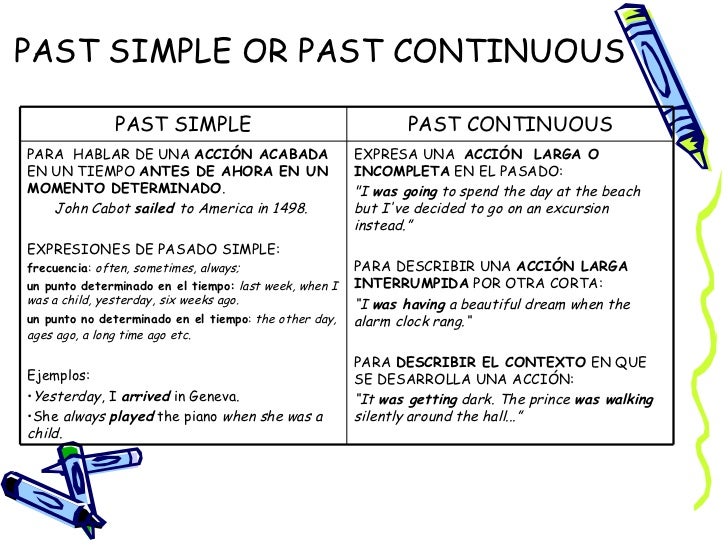
Past Simple Past Continuous

PASADO SIMPLE: VERBO EN -ED Ó 2ª COLUMNA SI ES IRREGULAR. NEGATIVA: DIDN'T + INFINITIVO.

PASADO CONTINUO: WAS/WERE + -ING // WASN'T/WEREN'T + -ING

1 Complete the sentences with the correct past simple or past continuous form of the verbs in brackets.

 1 She________ (surf) when the shark________ (attack) her.

 2 He___________ (dance) at a party when he__________ (meet) his girlfriend.

3 I_______________ (have) a picnic when I____________ (see) my sister.

4 When they_______________ (see) the shark they_____________ (swim) in the sea.

5 Susan_______________ (arrive) while I ________________(have) dinner.

6 He___________________ (play) football, when he______________(break) his leg.

7 I___________________ (wait) for my friend when the bus _____________(arrive).

 8 When I _________________(get back) my mum ______________(cook) dinner.


PRESENT PERFECT VS PRESENT PERFECT CONTINUOUS
Present Perfect Continuous VS Present Perfect Simple

PRESENTE PERFECTO: HAVE / HAS + -ed/2ª Columna. Negativa: HAVEN'T / HASN'T + -ed / 2º Columna. 

PRESENTE PERFECTO CONTINUO: HAVE/ HAS BEEN +-ING // HAVEN'T/ HASN'T BEEN +-ING 

Present Perfect Simple or Present Perfect Continuous Exercise 

 1. ___________________ (you / buy) your train ticket yet?

2. The kitchen is a complete mess! What ___________________ (the children / do)?

3. Julie ___________________ (learn) to drive for six years!

4. Amanda ___________________ (already / have) lunch, so she’ll meet us later.

5. How much coffee ___________________ (she / drink) this morning?

 6. Simon ___________________ (write) three books.


PAST SIMPLE VS PAST PERFECT

PAST SIMPLE; ACCIONES FINALIZADAS EN PASADO

PAST PERFECT: ACCIÓN QUE OCURRE ANTES QUE OTRA EN EL PASADO; La acción que ocurre primero va en pasado perfecto y la acción que ocurre después va en pasado simple.

EJEMPLOS: WHEN I ARRIVED TO THE CINEMA, THE FILM HAD ALREADY STARTED. ACCIÓN QUE OCURRE ANTES: THE FILM HAD ALREADY STARTED; VA EN PASADO PERFECTO. ACCIÓN QUE OCURRE DESPUÉS: I ARRIVED TO THE CINEMA; VA EN PASADO SIMPLE. 

EXERCISE: 
1. We had already eaten when John ________________________________ (come) home.

2. Last year Juan ________________________________ (pass) all his exams.

3. When I ________________________________ (get) to the airport I discovered I had forgotten my passport.

4. I went to the library, then I ________________________________ (buy) some milk and went home.

5. I opened my handbag to find that I ________________________________ (forgot) my credit card.


TAREA 2: RESPONDE A ESTAS PREGUNTAS SOBRE EL LIBRO "GULLIVER'S TRAVELS" (ESTÁNDAR 3.1.2)

Gulliver's Travels Audiolibros por Jonathan Swift - 9781520082103 ...


Gulliver’s Travels
Jonathan Swift
1 Match a description from A with the name of a place or person in the story from A
1 A country where everything was very large.
2 A country where everything was very small.
3 A human being who lives for ever.
4 A flying island.
5 The girl who looked after Gulliver during one of his adventures.
B
a Laputa
b Lilliput
c Struldbrug
d Glumdalclitch
e Brobdingnag

2   Are these sentences true (T) or false (F)?
a Gulliver was married.
b Gulliver found it difficult to learn the languages of other countries.
c In Brobdingnag, Gulliver’s master tried to make money by showing him to people at the market.
d The people of Laputa were very interested in mathematics.
e After spending a year with horses in the country of the Houys, Gulliver was very happy to leave so that he could be with human beings again.

 3 For each sentence, tick a, b or c.

1 Gulliver was a ... .
a doctor b teacher c soldier

2 The argument between the Big-Endians and the Small-Endians was about ... .
a ships b shoes c eggs

3 The King of Lilliput decided to punish Gulliver by ... .
a taking all his money b cutting off his hair c making him blind

4 Before Gulliver left Brobdingnag, he offered to tell the King how to ... .
a build a ship b make gunpowder c find gold

5 Gulliver was carried away from Brobdingnag by ... .
a a bird b the wind c a monkey

6 Gulliver found the Yahoos ... .
a__interesting b___friendly c__horrible

4, When he left Lilliput, what did Gulliver take with him to show his friends in England?

5. What was your favourite part of the story? why? 

¿Cómo iniciarse en los mundillos de eTwinning?

  Hello teachers!  La semana pasada recibí un mensaje por instagram de una compi preguntándome cómo iniciarse en los mundos de eTwinning.  E...